

Since the dawn of humanity, religious symbols have been profound vehicles of meaning, representing the mysteries of life, death, and creation. Among these, the figure of the Primordial Goddess, present in pre-Christian cultures, stands out as an archetype embodying fertility, creation, and connection to the divine. This symbolism intriguingly ties to the concept of parthenogenesis, the act of creation without male intervention—a theme that transcends ancient religions to find expression in Christianity through the Virgin Mary.
The Primordial Goddess and Parthenogenesis
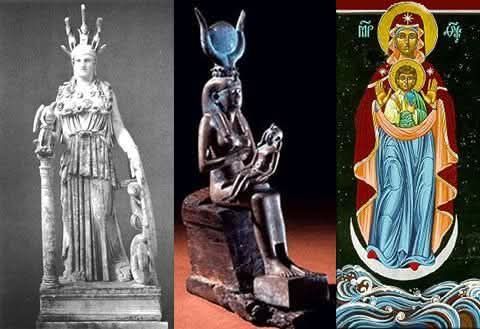
In many ancient cultures, the Goddess was regarded as the source of all life. Figures such as the Great Mother, Cybele, Isis, or Gaia not only symbolized fertility but also represented the capacity to generate life independently. In Egyptian mythology, Isis conceives Horus without a traditional physical union, an act of divine creation. In Greek myths, Gaia (Earth) gives birth to Uranus (Sky) and other beings without needing a male counterpart.
These narratives reflect parthenogenesis, a biological phenomenon involving reproduction without fertilization. While in nature it occurs in certain organisms, in mythology, it symbolizes the autonomous creative power of the feminine. This symbolism highlights the connection between women, nature, and divinity, positioning the Goddess as an archetype of self-sufficiency and power.
Integration into Christianity: The Virgin Mary
As Christianity emerged within the Mediterranean context, it absorbed and redefined religious symbols from pre-Christian cultures. The Virgin Mary, a central figure in Christianity, echoes these ancient goddesses. The virginal conception of Jesus through the Holy Spirit can be seen as an adaptation of the concept of divine parthenogenesis.
In Christian theology, Mary is the mother of God, immaculate and pure. This attribute not only emphasizes her divinity but also connects her to ancient archetypes of the Creator Goddess, capable of generating life without male intervention. Just as Isis protects Horus, Mary protects Jesus, with both figures serving as pillars of faith and hope for their followers.
Symbolic Continuity
While Christianity explicitly rejects pagan myths, the symbolic connection is undeniable. Mary’s image as a divine mother reflects the enduring universal longing to connect humanity with the sacred through the feminine. Her figure encompasses elements of motherhood, compassion, and creativity that have been present in Goddess archetypes since time immemorial.
The transition from the Primordial Goddess to the Virgin Mary is not merely a theological shift but an example of how cultures transform and adapt symbols to give meaning to new narratives. Through parthenogenesis, both ancient religions and Christianity celebrate the mystery of creation—a mystery that, at its core, continues to exalt the creative and divine power of the feminine.
This analysis invites us to reflect on the continuity of religious symbols and their ability to connect people with the transcendent, reminding us that, despite cultural and temporal differences, the essential questions about the origin and meaning of life unite us as humanity.
Our Lady of the Night.
Christian Ortíz.
- Tonantzin Guadalupe: Nuestra Señora buscadora.
- El movimiento de la Diosa: Ecoespiritualidad para ser y estar en la tierra.
- Baba Yaga: La Bruja del Bosque como Arquetipo y Entidad de Poder
- Oráculo de Diosas: Mensajes de Sanación y Poder
- ¿Dónde está Ella? La ausencia simbólica de lo femenino en la Trinidad
 Nuestra Señora de la Noche